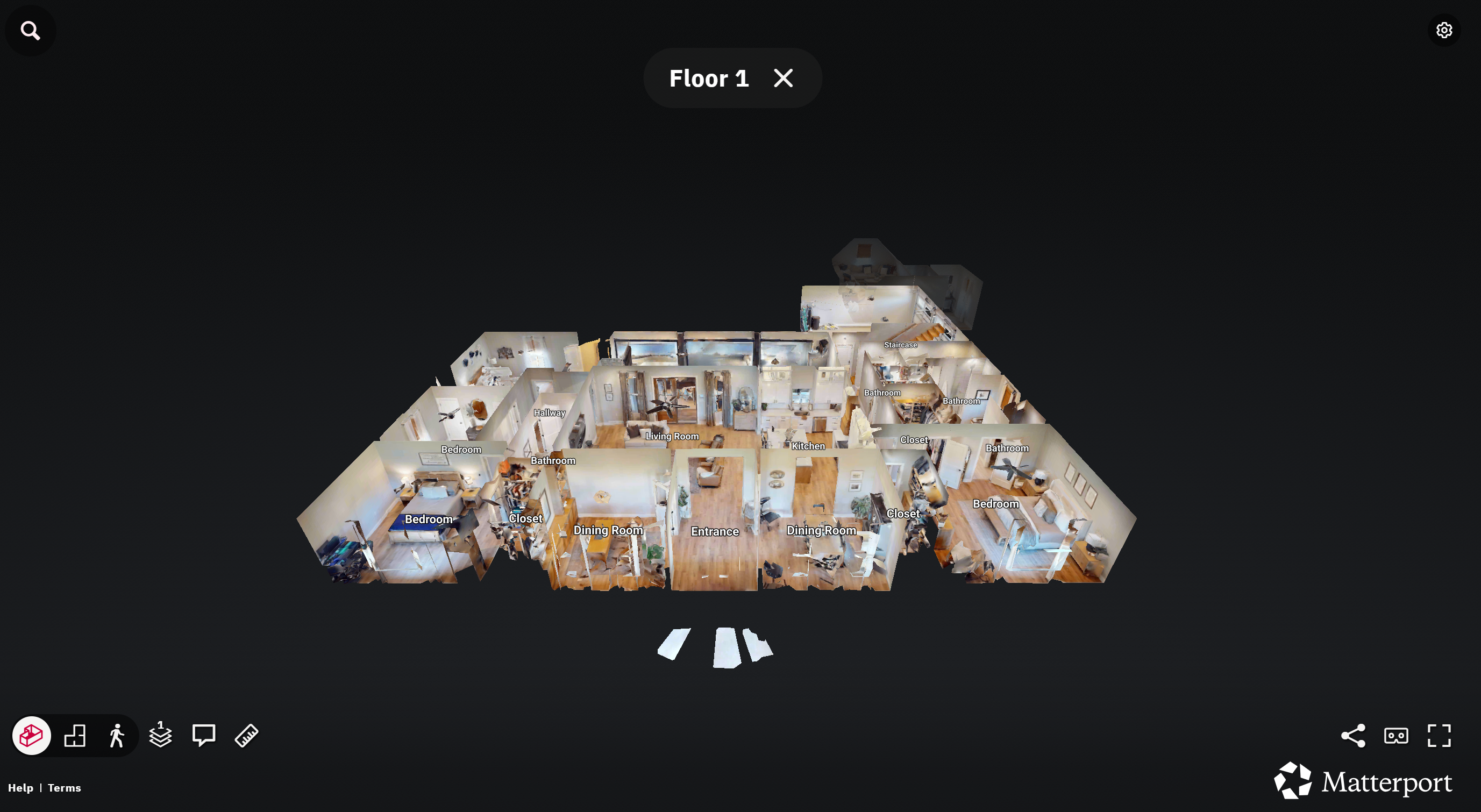
In a parish where flooding doesn't wait for a hurricane, a documented property is a claim backed by a record — not memory. A premium, done-for-you scan and tagged asset inventory, built for Acadiana homeowners and business owners who know exactly what's at stake.
DHDO provides 3D property documentation in Lafayette, LA — every room and every item, documented before you need it. A DHDO scan isn't a folder of phone photos.
It's a structured, navigable record of your entire Lafayette property — built once, ready whenever you need it, and stored off-site regardless of what happens to the physical house itself.
Every room, closet, garage, and outbuilding captured in an immersive, walkable 3D model — not a snapshot, a space you can move through.
Make, model, serial number, and purchase date embedded directly into the scan for every item you choose to document — furniture, electronics, appliances, valuables.
Your complete record lives in a private client portal, accessible from any device and easy to share with an adjuster, contractor, or family member the moment it's needed.
Lafayette Parish’s worst disaster in decades wasn’t a hurricane — and that’s exactly what makes the real risk easy to underestimate. Between recurring flooding and a steady run of Gulf storms, the question here isn’t really “what if” — it’s “when,” and “will I be ready.”
In August 2016, an unnamed rain system stalled over Acadiana for two days, dropping more than 20 inches of rain and pushing the Vermilion River to its highest level since 1940. An estimated 4,000 to 5,000 homes across Lafayette Parish flooded. Add two decades of Gulf storms on top of that — Rita in 2005, Gustav and Ike in 2008, Laura and Delta in 2020 — and the region’s real exposure runs well beyond hurricane season.
After a flood or a storm, floors get ripped out, damaged items get hauled to the curb before anyone thinks to photograph them, and receipts get lost in the scramble. A homeowner reconstructing what they owned from memory, weeks or months later, is starting from a disadvantage that was avoidable.
A DHDO scan is meant to help avoid that disadvantage. It’s built before the water rises or the wind picks up, stored off-site, and ready the moment a roof leaks, a fence goes down, or a home floods — regardless of what happens to the physical house itself.
DHDO scans homes, rental properties, and local businesses throughout Lafayette and the surrounding Lafayette Parish communities, including these areas:
Established Lafayette neighborhoods — River Ranch sits directly along the Vermilion River corridor — home to properties with decades of accumulated furnishings, art, and valuables worth documenting in detail.
Growing communities across Lafayette Parish, including upscale developments like Youngsville’s Sugar Mill Pond, sitting in some of the parish’s fastest-growing flood-risk corridors — homes in Youngsville’s Highland Ridge subdivision took on up to 20 inches of water in the 2016 flood.
Inland Lafayette Parish communities where wind, rain, and drainage — not storm surge — drive the real risk; homes near Scott’s Country Living Estates have flooded more than once in the past 15 years.
We serve the surrounding Greater Lafayette area and the rest of Lafayette Parish. If you’re a homeowner, HOA, or business outside these named areas, reach out — we’re likely already scanning nearby.
DHDO’s service area across Lafayette Parish and the surrounding Acadiana parishes.
If you don’t see your location listed on this page, please call or message to inquire if we will travel to your location.
Booking takes one phone call. From there, we handle everything — most Lafayette homes and businesses are fully documented in a single visit.
Call or fill out the form. Every inquiry gets a response within 12 hours, and most scans are booked within days.
One visit, start to finish. A DHDO operator walks every room, closet, garage, and outbuilding — or every classroom and common area, for a business — with our 3D camera. Nothing is touched or moved.
Furniture, electronics, appliances, and valuables are tagged directly in the model with make, model, serial number, and purchase date — plus a link to the item online where one exists, so an adjuster or contractor can see exactly what it is and what it currently sells for. If it’s listed online, we’ll find it. DHDO documents; it doesn’t appraise or assign values.
Your finished walkthrough, floor plans, still photos, and tagged inventory land in your private, secure client portal — ready to share with an adjuster, contractor, or family member the moment you need it.
Booking is done over a quick phone call. We'll schedule your scan and walk you through what to expect.
Book a ScanNot really. Lafayette has never taken one catastrophic direct hit, but it’s absorbed a steady string of storms over 20 years — Rita’s regional damage in 2005, Gustav and Ike’s wind in 2008, Laura and Delta’s wind and power outages in 2020 (Delta alone caused the 4th-largest power outage in Louisiana history, largely because it hit populated Lafayette directly, unlike Laura). And the parish’s actual worst disaster on record didn’t involve wind at all — the August 2016 flood, which ultimately damaged an estimated 4,000–5,000 homes parish-wide, wasn’t even a named storm. Waiting for “the big one” to hit here is exactly the gap this closes.
Yes. Most flooding in Lafayette Parish doesn’t come from the river overflowing its banks — it comes from the coulees that feed it, and from flash flooding that isn’t on FEMA’s official maps at all. A December 2023 storm flooded parts of Downtown that aren’t in any mapped flood zone. Local modeling that accounts for that flash-flood risk shows nearly half of everything built in Lafayette Parish since 2001 sits inside a broader flood-risk zone than FEMA’s map alone shows — so distance from the river isn’t a reliable measure of your actual exposure.
Yes — UL Lafayette’s roughly 12,000 students drive a large off-campus rental market with constant tenant turnover. A dated, tagged record of a unit’s condition and furnishings gives landlords and property managers a clear baseline for security deposit disputes and damage claims between tenants, not just for a catastrophic loss.
It matters more, not differently. Districts like Sterling Grove and Freetown-Port Rico include homes with original materials, millwork, and architectural details from the 1800s and early 1900s that cost far more to replace than a standard policy assumes. A detailed, tagged record makes the case for the specialized coverage — or claim value — that kind of home actually requires.
No. Plenty of Lafayette clients book without any disaster in mind — before or after a renovation, during estate planning, or simply because they’ve never had a real inventory of what they own. Local flood and storm risk is a strong reason to prioritize it, not the only one.